

Do you remember the courses on microeconomics you took back at the University? Those were among my favorites. I remember the theory of price elasticity demand. It’s very logical and rational – if you decrease the price you’ll increase demand (as long as the product is “elastic”) and if you’d increase the price you’d expect fewer sales. There is even a formula! The thing is though that this is a theory and it’s based on people making a rational cost-benefit analysis of the different product options, i.e. acting as “homo economicus” as Nobel economics laureate prof. Richard Thaler puts it… which is not quite what most people do.
We were once working with a client, one of the world’s leading premium tire producers. We shared with them some Behavioral Science principles and during the Behavioral Journey Mapping exercise, their representative for Saudi Arabia came in and shared a story with us. Their sales figures were disappointing and after speaking to some customers they decided to actually increase the prices so that they are the most expensive on the market. The results? Their sales increased severalfold! Why? Because people subconsciously judge the product quality by the price. If you ask someone to taste wine and tell him/her that it’s a $100 bottle you’d most likely hear lots of positives, but if you tell that person that it’s a $5 bottle, chances are that you’d hear a lot less positive reviews. BTW, we suspect in Saudi Arabia there might have been some social status motivation in play too.
People’s perception of price is affected by other biases too. When you go to a restaurant and order a bottle of wine, you most probably don’t order the most expensive, neither the least expensive but rather go for a mid-priced option. This is called Extremeness Aversion. Once at dinner in a restaurant, one of our clients who had been to sommelier classes said that she always orders the cheapest wine because there is not much difference in taste but in price there is! I have to say to date, I still don’t order to cheapest wine. Fear of shame proves unsurmountable to me!
There is also the Anchoring Effect. When you go to Royal National Lifeboat Institution you get presented first with a £150 donation option, then with £50 and a £20 option. So if you went to the website thinking you’d donate £10 and you see first the £150 option, suddenly you’re more inclined towards the £20 option. That’s because they have anchored your mind on the higher number first.
Here are some Behavioral Science principles that are important to take into consideration in the design of your customer experience.
The Peak-End rule
This is one of the most profound Behavioral Science principles for us. Prof. Daniel Kahneman, which first coined the term distinguishes between the “Experiencing self” and the “Remembering self”. The Experiencing self is you during your vacation, cinema, concert experience, etc. The Remembering self is you several days, weeks, months after you had that experience. So when the time comes to decide on whether or not to buy again from an organization, to recommend it, to renew your subscription it is the remembering self that makes the decision (unless you shop in the experience as in theme parks, etc.). So if you went to an André Rieu concert last year and this year someone asks you: “Was it worthy?”, it’ll be your remembering self that will answer that question. And your answer will be dependent on how you felt at the peak of the experience and at the end.
Through experiments, Kahneman shows that people’s recollection of an experience is dependent on how we felt at the peak of the experience, which could be positive or negative, and how we felt at the end. You won’t remember every minute of the concert but you’d remember a moment of culmination and probably the ending. In many instances, those key moments are purposefully designed but for the majority of organizations, those are left to chance. And therein lies the opportunity for many organizations. Don’t leave what customers will remember from their interaction with you to chance.
In our consulting practice, working with organizations, we have found many instances where this principle could be used to drive more sales and generate a lot more positive reviews.
For example, working with the financial arm of a leading manufacturer of earth-moving equipment, which offers extended warranty (insurance) for the equipment, we found that after the end of the 3-4-5 year contract they don’t do anything. And these are exactly the customers most likely to need a new machine or to extend the insurance. We found a similar opportunity for the mortgage clients of a bank. For the customers of an insurance company, we designed a positive peak in the experience that generates lots of positive comments.
Intuitive & Rational Systems
When we talk about Behavioral Science we must explain the existence of two systems that play a role in our decision-making. These systems are in constant battle, interexchange, or override one another. Talk about these systems goes all the way back to Aristotle, who distinguishes between soul and conscience, while your parents and friends talk about “heart” and “head”. Most psychologists use the terms System 1 and System 2 or Intuitive and Rational Systems.
The Intuitive System is always on, making quick decisions using rules of thumb. That’s the system you use when you act on “gut feel” or go with your instincts.
The Rational System is the one that makes you stop and think. It requires concentration over decision-making, requires more effort, and thus is cognitively depleting. The Rational System could approve or change Intuitive System decisions, neglect them, or be informed or influenced by it. So for example, the Intuitive System could say “hey, look at these running shoes – how nice they are, let’s buy them” and the Rational System could say – but we already have 3 other pairs in the closet, we don’t need anymore and overturn the impulse. Next time the Rational System simply may not have the energy to fight the Intuitive System, which says “hey it’s been a tough day, we deserve a beer to relax” and the Rational System responds “ok, whatever you say, so long to the diet once again”.
Another example would be when we are looking at and comparing the features of household goods which seem very similar. So after a long comparison the Intuitive System takes the lead and says “ok, let’s just go with Bosh, we could hardly go wrong” and the Rational System says “OK, I’m tired of reading features”.
The questions you need to ask yourself is:
- Which system do our customers use when making decisions?
- How do we appeal to the two systems?
Normally, you should be striving the make the decision look intuitive and easy, as the harder it is to make a decision, the more likely it is for customers to make no decision at all and do not buy your products or services (i.e. choice overload).
The Power of Habits
To avoid the cognitive depletion of the Rational System, we form habits to save energy and make things easy. Every habit consists of three parts – a “cue” – something that kicks-off the habit; a “routine” – the repeat behavior and a “reward”. Has it happened to you that you go under the shower in the morning, thinking about things and you forget whether you put shampoo or not? That’s because you are working on “automatic” based on the habit that is being formed and that frees your brain the think of other things (rather than – I need to open the shampoo, put it on my hair, etc.). Another one of our habits is buying the same toothpaste brand.
Marketers are well aware of habits and are strategizing how to break existing habits when introducing new products (thus putting big boards with a new product at the supermarket, giving away samples, etc.) or are trying to make the use of their product to be habitual i.e. “Eat, Drink, Chew Orbit” or the new 7Days mini commercial, that tries to associate drinking coffee with eating a mini 7days croissant.

Think about your shopping habits. If you are used to shopping at a supermarket where the fruits and vegetables are weighted at the cash register but from time to time you shop at a supermarket where you have to weigh these yourself prior to going to the cash register you, you often forget to do so out of habit.
So the questions for marketers are:
- How do we break people’s habits when introducing our products?
- How do we create using our products habitually?
The questions for customer experience professionals are:
- What habits do our customers have today that influence their behavior using our products and services?
- How we can use the power of habits in our experience?
The Goal Gradient Effect
The Goal Gradient effect states that the closer to the reward/goal people are, the more they accelerate their behavior to reach their goals. In other words, people are more motivated by how long is left to reach their target.
Experiments on this subject showed that rats run faster as they approach a food reward (Hull, 1934), and humans increase effort as they approach rewards such as gift certificates (Kivetz, Urminsky, & Zheng, 2006) or goals such as visual finish lines (Cheema & Bagchi, 2011).
The closer customers get to their goal, the more encouraged they become to finish. But they can’t get motivated if they don’t know where the finish is.
For this reason, you’ll often see the Goal Gradient Effect at work in gamification elements like progress bars, badges, and profile completion percentages. It can be applied anywhere users are encouraged to complete a big task by achieving smaller objectives.

LinkedIn is using a progress bar to nudge you to complete your profile by sharing more information. This will get you closer to your goal by making your profile attractive to recruiters, Starbucks and other shops are using loyalty cards or points where you could earn free coffee, etc.
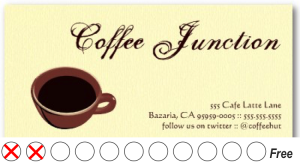
We applied this principle when working with a frequent flyer and frequent purchase program of a global airline. The program was losing 1/3 of its customers after redeeming a huge number of points for a transocean flight or vacation. Using this principle, along with other measures such as more personalized communications and offers, we offered customers the option to choose a new target, for which to collect points and added a progress bar. Moreover, after a big points redemption, there were some bonus points offerings so people can back on the long road towards their new goals.
Priming
Priming is a phenomenon in which our minds call on subconscious connections in response to a stimulus (prime). The stimulus could be images, words, smells, etc.
In one experiment in a supermarket, they played French and German music on alternative days. When German music was played, sales of German wines went up 5 to 1, and the same thing happened when French music was played. Interestingly, when shoppers were asked outside the supermarket why did they buy that wine, no one mentioned the music.
The smell could also be a prime. Supermarkets pump the smell of freshly baked bread and bakery throughout the store to increase sales. Here’s also a tip from us, if you want to increase your chances of selling your house, bake some fresh coffee o cookies. We associate the smell with memories from our childhood and the feeling of home coziness.
Primings works with images too. In one experiment, women were nudged to feel more confident when speaking, when there were pictures of influential women such as Hillary Clinton and Angela Merkel hanging in the hall. Temperature, words, light could also be primes.
Other Behavioral Science principles are the Loss Aversion Bias, Social Proof, which we looked at in a previous blog about the cognitive biases we exhibit in times of crises and other circumstances. We are going to look at more Behavioral Science aspects in subsequent posts.