

How do economies change? Joseph Pine and James Gilmore start with this question their notorious article in Harvard Business Review “Welcome to the Experience Economy”. The authors develop the thesis that the world enters into the era of the Experience Economy and most organizations will be competing on the basis of the experience they provide to customers. You can see the phases of economic development by seeing how making a cake has changed over the years.
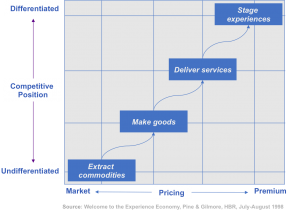
Before, our mothers use to buy the raw ingredients like four, eggs, sugar, and milk so they can make the foundations and then the cake itself. Later on, merchants started to offer ready foundations and cake mixes, and even ready cakes. Nowadays, not only there are lots of bakeries, who can decorate the cake with a picture of your choice, but even firms that can organize the whole party for us – from the cake, through to decoration and even the entertainment. At this point, they compete on the basis of the experience itself (not just the product – the cake). You can also see that the margin, firms can charge also grows as you move up the ladder. One thing is to buy just the raw ingredients, a much more expensive option is to buy the whole cake and a whole lot more expensive option is to outsource the whole experience to a specialized organization.

And so, nowadays, if a business wants to avoid price competition and charge higher premiums, it needs to think about the holistic experience of customers. This way Starbucks doesn’t sell coffee for $0.40 but for $4. That’s why theme-based restaurants like Rainforest Café, Hard Rock Café, etc could charge premiums and operate on a franchise model.
12 years later, Forrester prоclaims that from 2010 the world enters the “Age of the customer”. The 60s were the “Age of manufacturing” where industrial giants like Ford, Boing, Sonny, P&G flourish. Then follows the “Age of distribution”, with notable representatives such as Walmart, Toyota with their “just-in-time” logistics system, UPS, etc. The 90s mark the entrance of computers and the internet in households around the world and the rise of companies like Google and Amazon. Now, we’re in the Age of the customer, where customers have a wide range of choices and an abundance of information sources, methods of communication. The power has shifted in their favor and one complaint or compliment gone viral could have a big influence on a merchant’s sales.
Samsung shares its vision for the future in a video and says that we are in the #ageofexperience. For me, the song and video from Dave Caroll from 2009, United Breaks Guitars is the epitome of entering the age of the customer and the power shift towards customers. Dave is a musician and upon checking-in his guitar he tells staff of United Airlines to please be careful not to break it but his pledge is met with indifference. So are his complaints after finding out his guitar is broken. After 9 months, he is refused even a $1200 settlement, even though his guitar is custom made and costs even more. So Dave, being a musician records a song and a video about his experience as a customer. On the first day, the video is seen by 150,000 people and in 30 days it gets 5m views. This time United offers a much more generous compensation and the $1200 saved back then has cost them more than 15 million views and a real PR disaster.
According to Gartner, 89% of marketing managers expect to be competing mostly on the basis of the experience they provide to customers. No wonder, given some of the facts below:
- It costs 6 – 7 times more to acquire a new customer than retain an existing one – Bain & Company
- The probability of selling to an existing customer is 60 – 70%. The probability of selling to a new prospect is 5-20% – Marketing Metrics
- The probability of selling to an existing customer is 60 – 70%. The probability of selling to a new prospect is 5-20% – Marketing Metrics
- A 2% increase in customer retention has the same effect as decreasing costs by 10% – Leading on the Edge of Chaos, Emmet Murphy & Mark Murphy
- Loyal customers are five times more likely to purchase again and four times more likely to refer a friend to the company – Forbes
- Offering a high-quality customer experience can lower the cost of serving customers by up to 33% – Forbes
- 3 out of 4 consumers have spent more with a business due to a prior positive customer experience – American Express
The opportunity to differentiate is huge!
The Banking Sector
This is a sector with a lot of opportunity for innovation and also a sector that is coming under pressure by FinTech companies. A 2020 study in the UK found that within 5 years 44% of brits will have a digital-only bank. In another experiment, people found that it could take between 2 to 36 days to have an active banking account. Creating the account could take between 24 in the case of Revolut to 120 clicks in the case of first direct, which by the way is a phone and online-only bank and are one of the leaders in customer experience in the UK.
One of the challenges for the baking sector is to cater to Millennials, many of whom find ways to bypass the traditional way of banking. This is critical because about 60-70% of mortgage loans go to current customers of the bank. That’s because current customers are likely to always ask for an offer from their bank and get offers from 2-3 other banks. So gaining a market share in the Millennials segment is important because they will be the driving force in the mortgage market of the future.
Digital Transformation also allows the gathering of more data on customers. This is a gold mine for banks as long as they know how to use it to personalize offers to customers and find how to cater to different kind of customers – some that seek economic value (low fees, bonus offers, etc.), some that seek functional value (i.e. speed of service), some that seek experiential value (quality service) and those that seek Symbolic value (i.e. Status Symbol – think of exclusive credit cards with benefits, etc. or baking with a company they share similar values).
Insurance Sector
This is another sector where customer experience could be a huge differentiator. Typically there is a huge amount of customers switching providers every year but the competition is stiff. Yet the reason so many customers are switching, other than price, is the poor experience so many customers have had. A challenge for this sector are the rising litigation costs who keep pushing premiums up. This is also another sector where digital transformation could have a huge impact – from filing a claim, through to the management and communication along the claim process, through to data mining and flagging customers at risk of defection, high/low-risk profile customers, etc. One UK insurance company – LV=, found a link between customer efforts and customer satisfaction on one side and policy renewals on another. They found that when Customer Satisfaction is <65%, 30% of customers do not renew their policies. When Satisfaction is between 75-84%, they half as many customers – under 15%. And when Customer Satisfaction is above 85%, less than 10% don’t renew their policies.
IT Sector
A big part of the IT sector is in the B2B segment. Contrary to conventional wisdom, where one might think that in B2B it all comes down to rational decisions and price, we have found that customer experience is even more important. While you could afford to make a mistake buying a new pair of shoes from an unfamiliar brand or an online website, in the case of B2B the stakes are much higher and a misstep could impact the quality of the companies products or the services it delivers to customers. Another interesting part here is that F2F interactions are rare and most of the interactions are over e-mail, chats or via phone. This makes “reading” the customer even more difficult and we have found the interactions between customers and the customer support function is to be a common problem for young IT companies. We’ve been shown e-mails sent to C-level executives by employee who have no idea who they are dealing with and the tone and lack of emotional awareness has been mind-blowing. Not that many organizations however have defined the experience they want to provide and have equipped employees with the skills to evoke the desired emotions.
Another typical problem is that people don’t know what they don’t know. They may be brilliant engineers but may not know about customer emotions and all the behavioral science principles that affect how customers perceive things. This is a common problem in the healthcare sector so we’ll describe it below.
The Healthcare Sector
Unlike in the US, where each hospital is measuring patient satisfaction and can benchmark its results on a regional and national level, this is not that common in the rest of the world. I’ve seen this first hand when my partner was pregnant. As it typically happens, after checking for recommendations from several places, she was referred to a practitioner at a brand new branch of a private hospital system very close to where we live. We chose a private hospital hoping for a better service and less wait. We bought a package for multiple visits but we were about to give up on the hospital on the 2nd visit. We had an appointment for her doctor, but after a short examination, the doctor referred us to the cabinet of another doctor down the hall, where to have an ultrasound scan. The only problem was that we did not have an appointment for this second office. We waited about 30-40 min without anyone giving us any information whatsoever. My partner started to lose patience, so when I saw someone walking out of the office, I asked nicely where in the queue order are we. The doctor’s answer – “You are outside the queue order” – meaning we didn’t have an appointment. She immediately softened the tone however and told us that there are a couple of women ahead of us but expects to see us in 20-30 min. This answer made my partner stay. I had another appointment and had to leave as this had taken way more than I anticipated. Later my partner told me that the doctor was one of the leading professionals in her field and they were using the latest technology in the field. This made me think about the fact that despite all that, earlier that day we were on the brink of leaving the hospital and never coming back (the bulk of the money the hospital would receive during childbirth, so they were about to lose a significant amount of money).
My conclusion was that “people don’t know what they don’t know”. This physician may be a great professional, having spent years of studying and practicing the profession of a gynecologist, but she most probably has not read about the psychology of wait time and I doubt that she reflects too much on the aspects of the patient experience. And I don’t think it’s her job. But how many hospitals that you know of have a Chief Patient Officer or someone in charge of patient experience at a senior level?
One of the principles of the psychology of wait time says ”unknown wait feels longer than known wait”, Another one says “unexplained wait feels longer than explained wait”. In the US hospitals, when there is a delay, physician assistants inform patients (often before they even arrive) about delays and explain the reasons behind those i.e. the doctor had to go into an emergency operation.
Just a few days ago, in the midst of the Covid-19 pandemic, a family, friends of ours, had twins. They have too changed the hospitals because of a bad experience. My mother has cancer… to date, her physician has not spoken to me or my father. When you consider the amount of lost revenue for these hospitals and the likelihood to recommend or defer other people from using their services you get to some significant numbers and therein lies the opportunity to benefit from a superior customer experience.
These are just some of the examples for sectors where there is a huge opportunity to achieve customer-driven growth and improve financial performance by working on customer experience. Similar opportunities lie in the energy provider’s sector with the trend towards free competition in the market, the supermarket business, the parcel delivery services, the hospitality industry, the government administration, and so on.
In my experience other than companies from the above-mentioned industries, we’ve worked with water utility companies, a manufacturer of in-flight entertainment systems, whose clients were no more than 30-40 airlines, a manufacturer of fixtures, a medical records software company for care homes, and many more. Each of them had seen in customer experience a way to retain more customers, increase customer acquisition, lower costs by reducing the need for service and even lower the recruitment costs and attracting better talent by improving the brand image (not many talents want to work for a company with a bad reputation).
That is why more and more organizations are developing strategies to improve the customer experience. Do you have a Customer Experience strategy? Do you know which aspects of the experience drive the most value for you?